


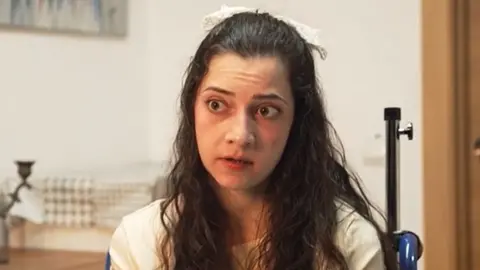
 Y Ahora Sonsoles (Atresmedia Television)
Note: This article contains references to sexual violence and suicide.
The death by medically assisted death of a 25-year-old Spanish female after a protracted court fight with her father has triggered discussion about the role of the government in caring for her and why it took so long to implement her desire to die.
Noelia Castillo, who had been rendered paraplegic due to injuries suffered when she attempted to end her life in the year 2022, passed away on Thursday evening at a Barcelona medical center.
The Catalan local authorities had granted her the authorization to assisted dying in 2024.
However, the procedure was halted at the last moment following court challenges filed by her father, supported by the campaign group a Christian legal group.
The case has received enormous attention in the country, with Christian Lawyers trying to block her death until the last moment.
Following an year-and-a-half legal battle, the European Court of Human Rights (ECHR) ruled this week in Noelia Castillo's favour and her death was eventually confirmed late on Thursday.
A Troubled History
She had spent much of her childhood in state institutions and had described the effect on her psychological well-being of her parent's issues with alcohol and of being assaulted by an ex-boyfriend and also by several individuals in a nightclub.
In a television appearance this week, she stated no one in her family had supported her choice to undergo euthanasia, and her parent "hasn't respected my wish and never will".
"I want to pass in peace now and end suffering," she told a TV network the day before she died.
Her mother had not agreed with her choice but was with her at the hospital.
A ex-friend of Castillo, a friend, attempted to enter the hospital to persuade her to reconsider, but informed reporters that officers had prevented her from entering.
A UK pianist living in Spain made an plea to her via online platforms to think again and proposed to cover her healthcare expenses until she felt "able to take this choice from a somewhat more peaceful state of mind".
Institutional Failures Debated
Christian Lawyers warned that her situation had highlighted failures in her support.
"For a young woman who obviously has had a very tough existence, which we all regret, the only thing that could be provided to her by the healthcare system is death," said a spokesperson for the group.
The opposition conservative party, which voted against a 2021 euthanasia law, had a comparable reaction.
"The institutions that should have safeguarded Noelia failed her," posted the party's head on social media. He added: "I refuse to accept that the government did not have the tools to give her proper support."
In a declaration, the Catholic Church, stated that Castillo story "demonstrates an build-up of personal suffering and systemic letdowns".
Legal Hurdles and Support
However, other commentators have taken issue with the fact that her wishes were blocked by court appeals put in her way by her parent and the Christian lawyers.
"The wish to put an end to her pain by using the legal right to assisted death was… undermined by a legal crusade that inflicted almost two years of suffering to her existence," noted a progressive publication in an editorial.
A lawmaker for a left-wing political coalition remarked that "Nineteen doctors have supported her choice and we should be respectful of it", while adding that it was a "profoundly complex" issue.
Spain's Assisted Dying Law
Spain is one of a small number of EU nations, such as the Netherlands, Belgium and Luxembourg, that have enacted laws permitting medically assisted death to be performed by physicians.
Under the 2021 law, any Spanish adult over 18 requesting assisted dying must be suffering from an untreatable illness or "serious, chronic and disabling ailment" and their choice must be taken without external pressure.
The request needs to have been expressed on two occasions in written form and has to be validated by a physician who then consults with a second medical professional.
The application then goes to a review committee, which has the role of assessing if the conditions have been fulfilled.
Based on government data, four hundred and twenty-six requests for assisted dying were approved in 2024, the most recent year for which data is accessible. This was the first time that a case went to court for a court to decide.


